CHAPTER 14 – HAZARD COMMUNICATION PROGRAM
A. References
- WAC 296-901 Hazard Communication
- WAC 296-800-180 Material Safety Data Sheets
- EH&S Safety Data Sheets
- SDS Request Form
- SPPM 5.10 Chemical Hazard Communication Program
- EH&S Chemical Safety
- SPPM 5.66 Recycling or Disposal of Chemical Wastes
B. Appendices
- Appendix A: Glossary
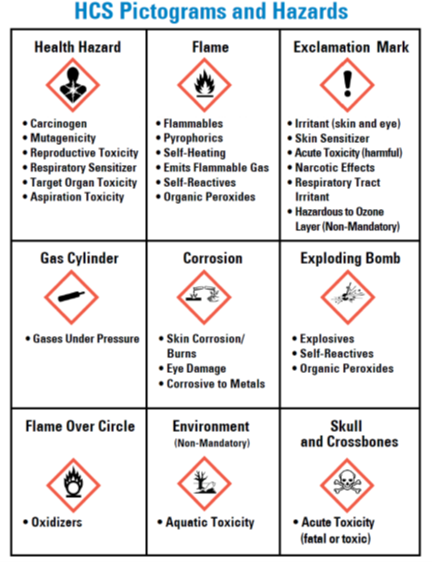
- Appendix B: Globally Harmonized System (GHS) Pictograms
C. Scope
This chapter covers the requirements for chemical hazard communication where , as an employer, provides information to employees about the hazardous chemicals to which they are exposed. The chemical hazard communication includes labels and other forms of warning, safety data sheets (SDS), information and training.
D. Responsibilities
Hazard Communication Program Manager
The EHS Occupational Health and Safety Hazard Communication Program Manager is responsible for the following:
- Developing this written hazard communication program; and,
- Maintaining a list of workplace hazardous chemicals and SDS for EHS workplace hazardous chemicals on the EHS server.
Supervisors
Supervisors are responsible for the following:
- Obtaining and making available the SDS to the employee;
- Ensuring workplace hazardous chemicals are labeled per this chapter’s requirements;
- Understanding this chapter’s requirements; and,
- Ensuring employees receive hazard communication training including the contents of this chapter.
Employees
Employees are responsible for the following:
- Informing their supervisor when workplace hazardous chemical labels are damaged or otherwise inadequate;
- Contacting their supervisor as needed for assistance interpreting SDS; and,
- Understanding this chapter and participating in hazard communication training.
General Policy
The EH&S OHS Hazard Communication Program Manager has overall responsibility for the program. A copy of this program and the safety data sheets (SDS) are readily available on the EHS server.[SBBD2] The EH&S OHS Hazard Communication Program Manager is responsible for obtaining , storing, and making available every SDS for every chemical obtained or created by an employee, guest, or student of the VCEA. The EH&S OHS Hazard Communication Program Manager is responsible for interfacing with any chemical inventory maintained in compliance with WSU policy with minimal interruption to the creators of the inventories.
Hazard Communication Standard Summary
The Hazard Communication Standard is based on a simple concept – employees have both the need and right to know the identities and hazards of the chemicals they are potentially exposed to when working. Employees also need to know what protective measures are required. This knowledge should reduce work-related injuries and illnesses caused by chemical exposure.
The Hazard Communication Standard establishes uniform requirements incorporating the Globally Harmonized System of Classifying and Labeling Chemicals (GHS) to assure that the hazards of all chemicals imported, produced or used in U.S. workplaces are evaluated. The hazard information and associated protective measures are to be transmitted to affected employers and potentially exposed employees.
Chemical manufacturers and importers must convey the hazard information they learn from the evaluations to employers by labels on containers and SDSs. All covered employers must have a hazard communication program to convey this information to their employees through container labeling, SDSs, information and training.
Chemical Inventory List
The EH&S OHS Hazard Communication Program Manager will maintain a list of the hazardous chemicals used by the VCEA employees or known to be present in the department’s buildings and update the list as necessary on the EH&S server. The list will be updated immediately upon receipt of any newly acquired chemical(s). The identity of each chemical on the list must match the product identifier on the container label and on the SDS. The inventory tracking list must include the following information for each chemical: product identifier on the container label, manufacturer name and attached SDS file (or link to it). Optional items may include: unit name that is primary user of chemical and building name where chemical is located. The unit supervisor will determine the required tracking items beyond the mandatory items listed above. The inventory tracking list will be maintained off the EH&S server under the SDS Tracking list.
- Container Labeling
The unit supervisor is to ensure all primary and secondary containers of hazardous chemicals in their area are properly labeled. Labels on containers from the manufacturer or distributor are to list the following six items:
- Product Identifier (Identity of the hazardous chemical(s) on a label or SDS);
- Signal Word (Danger or Warning);
- Hazard Statements;
- Pictograms (see Appendix 2);
- Precautionary statements; and
- Name, address and telephone number of the chemical manufacturer, importer, or other responsible party.

All secondary containers are to be labeled, tagged or marked upon transfer of the product to the secondary container by the person handling the product. Information on secondary labels must include, at minimum, the product identifier and hazard information from the manufacturer’s label and/or SDS. Additional information from the six items listed above may be used as necessary to enhance hazard communication. Information not on the label must be conveyed to the employee(s) through information and training.
If manufacturer provided labels are not available for the secondary containers, all units shall utilize a label which meets the requirements of the Hazard Communication Standard for secondary containers as described in the previous paragraph. Labels utilizing the National Fire Protection Association (NFPA) or Hazardous Materials Identification System (HMIS) hazard rating system may be used (example above and to the right). It shall be noted that this style of label by itself does not meet the requirements of the Hazard Communication Standard, therefore any additional information on the chemical substance must be conveyed to the employee through information and training.
For labeling assistance see the unit supervisor or refer to WAC 296-901-14012.
G. Safety Data Sheets (SDS)
A SDS (formerly referred to as MSDS and now structured differently for compliance with the Globally Harmonized System of Classification and Labeling of Chemicals, or GHS) is any printed or written document obtained or developed by the chemical manufacturer or importer for use by the end user of the product. The SDS must follow the specific content as described in WAC 296-901-14014. The SDS must include all 16 Sections as outlined in the Hazard Communication Standard.
Chemicals Encountered in VCEA Controlled Areas
For chemicals stored or used in VCEA controlled areas, the unit supervisor is responsible for writing a chemical hygiene plan and keep a chemical inventory in compliance with WSU policy. The unit supervisor shall confirm that appropriate SDSs are present and available to the employees which they supervise.
Chemicals Encountered in Laboratories or Shops
Routine activities (such as lab inspections or safety consultations) will require VCEA personnel to work among hazardous chemicals either in storage or in use. Lab personnel, specifically Principal Investigators (PIs), are responsible for obtaining SDSs for all chemicals in their respective labs. Therefore the general VCEA personnel do not need to have immediate access to those SDSs in order to enter the laboratory or shop. However, those SDSs shall be readily available on request to lab personnel.
Obtaining SDSs
SDSs may be obtained by contacting the manufacturer or supplier, searching the internet, visiting the Environmental Health and Safety and Risk Management website (www.ehs.wsu.edu) or by following the procedures in the Safety Policies and Procedures Manual (SPPM 5.10).
Communicating SDSs
The unit supervisor is responsible for reviewing incoming SDSs for safety, health and employee protection information and conveying any new information and training to affected employees. If there are questions or concerns, the unit supervisor shall be available for assistance.
Documenting SDSs
SDSs will be documented and be available to all employees during their work shift for review via online access to the EH&S server. For those employees without computer access, the unit supervisor will inform employees how they may obtain SDS information and provide it to them upon request. If so requested by the employee, the supervisor is responsible for obtaining a printed copy. If SDSs are not available, immediately contact your supervisor. Refer to this Chapter’s Employee Exposure Records section for additional information.
For more information on SDSs refer to WAC 296-901-14014.
Employee Information and Training
All employees will receive training on the Hazard Communication Standard, including updated labels and SDSs affected by GHS, upon initial employment. The unit supervisor is responsible for organizing employee Hazard Communication training. Training will be conducted by a person knowledgeable and competent in the topic (the supervisor is responsible for determining the competent person for providing this training in their unit).
Prior to starting work, employees using, or potentially exposed to, hazardous chemicals receive initial training on the Hazard Communication Standard and the safe use of those chemicals. Additional training shall be conducted when a new chemical hazard is introduced into the workplace and as needed. Training will be conducted before employees use or work in the vicinity of a hazardous chemical. Employee training is to be documented by recording the employee names, and the date and content of the training. See APP Chapter 30 – Safety and Health Training for instructions on documenting the training records.
The following training and information is provided to each employee covered by this program:
- A summary of the Hazard Communication standard and the purpose, location and availability of the written program, the list of hazardous chemicals, and associated SDSs. A summary of the standard is at the beginning of this chapter.
- Information identifying any operations in employee work area where hazardous chemicals are present.
- Information and training on reading chemical labels and reviewing SDSs to obtain appropriate hazard information. The glossary at the end of this program lists some common SDS terms.
- Information and training on the physical and health hazards and/or any other hazards of the chemicals in the work area, including the likely symptoms or effects of overexposure. The glossary at the end of this program lists some common physical and health hazard terms.
- Training on the methods and observation techniques used to determine the presence of a hazardous chemical release. Detection methods may include monitoring devices, visual appearances or odor.
- Training on the measures the department has implemented to minimize employee exposure to hazardous chemicals. These measures may include engineering controls, specific work practices employees must follow and the use of personal protective equipmentto minimize chemical exposure.
- Training on the emergency procedures to initiate in the event an employee is exposed to a hazardous chemical.
- Training on the procedures required for cleaning up chemical spills.
If an employee has been exposed to a hazardous chemical refer to the “Chemical Exposure Incident Procedure” section of this program for instruction.
For more information on Employee Information and Training, refer to WAC 296-901-14016.
Entering Laboratories
VCEA personnel can potentially be exposed to hazardous chemicals when entering research or teaching laboratories while providing services. See APP Chapter 17 – Laboratory Safety.
VCEA personnel are to review signs posted at the entrance of the laboratory for information about potential hazards and the appropriate protective measures. Some laboratories should not be entered without an escort from the respective laboratory or department (i.e. active laser laboratory). Supervisors and employees are encouraged to directly communicate with laboratory personnel for additional information about potential hazards and protective measures.
Chemical Spills
VCEA employees, not specifically trained in incident response/spill clean-up can clean-up chemical spills ONLY when all of the following conditions are met:
- The spill is located within the employees normal work area.
- The chemical is known and the spill can be cleaned-up in 15 minutes or less.
- Employees are trained to safely clean-up small chemical spills.
- Employees can wear the same personal protective equipment that they wear during normal work activities in which the chemical is handled.
- Appropriate clean-up supplies are readily accessible.
- The chemical does not have a Ceiling Limit listed in WAC 296-841 and cannot create an Immediate Danger to Life and Health (IDLH) atmosphere. IDLH information can be found in the NIOSH Pocket Guide to Chemical Hazards.
- Clean-up materials are disposed of per SPPM 5.66.
If any of the above conditions cannot be met, then immediately call 911 and qualified emergency response personnel will respond to clean-up the spill.
Only specially trained EH&S personnel can clean-up spills in campus buildings where these conditions are not met or where the spill involves mercury. See Chapter 29, Chemical Spill Response.
Personal Protective Equipment (PPE)
Supervisors are to perform hazard assessments for each work task to evaluate whether hazards, including chemical hazards, are present, or are likely to be present, requiring the use of engineering controls, administrative controls, and/or PPE (see SPPM 3.10) and APP Chapter 24 – Personal Protective Equipment.
Supervisors are responsible for evaluating chemical hazards, selecting suitable, properly fitting PPE and ensuring that staff are properly informed and trained on the use of selected PPE using information from the SDSs, container labels and other resources as necessary per SPPM 3.10 and the EH&S Personal Protective Equipment SOP. See APP Chapter 24 – Personal Protective Equipment. Employee PPE training shall be documented.
Building Occupants
Non-VCEA building occupants may work within and around VCEA workplaces while VCEA is working on specific projects which may include the use of hazardous chemicals. The project supervisor will inform building occupants of hazardous chemicals used by VCEA, the availability of SDSs and any required protective measures. This notification will take place prior to the start of a project and as needed during the life of the project.
On-Site Contractors
Contractors (e.g. Facilities Services, outside contractors), in the course of their work, may use hazardous chemicals in VCEA employees’ vicinity. The unit supervisor will request SDSs for chemicals used by contractors. Contractor SDS’s will be made available to VCEA employees.
Hazardous Non-Routine Tasks
Periodically, employees may be required to perform non-routine tasks involving hazardous chemicals. Prior to starting work on any non-routine task the supervisor or designee will conduct a PPE hazard assessment and provide affected employees with the following information and training:
- The specific hazards related to the non-routine tasks
- Protective measures required
- Steps the department is taking to reduce chemical hazards
- Emergency procedures
- How to procure, use and maintain PPE as determined by the PPE hazard assessment
Hazardous Substances in Unlabeled Pipes and Process Equipment
Employees required to work on or near unlabeled pipes and/or process equipment will be informed of the substances in the pipes and/or process equipment (or substances that can be reasonably expected to be present), potential hazards and protective measures. If you encounter equipment or piping where you are unsure of the contents, contact your supervisor for guidance.
Chemical Exposure Incident Procedure
In the event an employee may have been overexposed (inhalation, ingestion, injection, or skin contact) either accidentally or possibly to a hazardous chemical, after the necessary medical care has been provided, the supervisor must complete an “Incident Report” form (see SPPM 2.24). The following information should be included on the form: the specific chemical(s), the duration of the exposure, the type of exposure (inhalation, ingestion, injection, or skin contact), and personal protective equipment used. Environmental Health and Safety retains this form for 30 years post-employment as an employee exposure record.
Employee Exposure Records
WAC 296-800-180 defines SDSs as employee exposure records, which must be preserved for at least 30 years post-employment. The SDSs for chemicals no longer used by VCEA or chemicals which are used but no longer produced shall be retained and maintained for 30 years by EH&S, including MSDSs for chemicals ceased being used or produced before the June 1, 2015 transition to the SDS format compliant with WAC 296-901. The unit supervisor is responsible for updating the last known date of use in the department’s.
Reviewed by:
Appendix 1: Glossary
Carcinogen: a substance or agent which induces cancer or increases its incidence
Chemical: means any substance, or mixture of substances.
Classification: means to identify the relevant data regarding the hazards of a chemical; review those data to ascertain the hazards associated with the chemical; and decide whether the chemical will be classified as hazardous according to the definition of hazardous chemical in this section. In addition, classification for health and physical hazards includes the determination of the degree of hazard, where appropriate, by comparing the data with the criteria for health and physical hazards.
Common name: means any designation or identification such as code name, code number, trade name, brand name or generic name used to identify a chemical other than by its chemical name.
Corrosive: A chemical that produces destruction of skin tissue, namely, visible necrosis through the epidermis and into the dermis
Flammable Liquid: A liquid having a flash point of not more than 93°C (199.4°F). Flammable liquids with a flash point >140°F and ≤199.4°F are identified as “combustible liquids” on the SDS and label.
Flashpoint: The minimum temperature at which a liquid gives off vapor in sufficient concentration to form an ignitable mixture with air near the surface of the liquid .
Hazard category: means the division of criteria within each hazard class, e.g., oral acute toxicity and flammable liquids include four hazard categories. These categories compare hazard severity within a hazard class and should not be taken as a comparison of hazard categories more generally.
Hazard class: means the nature of the physical or health hazards, e.g., flammable solid, carcinogen, oral acute toxicity.
Hazard statement: means a statement assigned to a hazard class and category that describes the nature of the hazard(s) of a chemical including, where appropriate, the degree of hazard.
Hazardous Chemical: Any chemical which is classified as a physical hazard or a health hazard, a simple asphyxiant, combustible dust, pyrophoric gas, or hazard not otherwise classified.
Health Hazard: A chemical which is classified as posing one of the following hazardous effects: Acute toxicity (any route of exposure); skin corrosion or irritation; serious eye damage or eye irritation; respiratory or skin sensitization; germ cell mutagenicity; carcinogenicity; reproductive toxicity; specific target organ toxicity (single or repeated exposure); or aspiration hazard. The criteria for determining whether a chemical is classified as a health hazard are detailed in WAC 296-901-14022, Appendix A-Health hazard criteria.
Irritant: A chemical, which is not corrosive, that causes a reversible inflammatory effect on living tissue by a chemical action at the site of contact.
Label elements: means the specified pictogram, hazard statement, signal word and precautionary statement for each hazard class and category.
LEL, or LFL: Lower Explosive Limit, or Lower Flammable Limit, of a vapor or gas; the lowest concentration that will produce a flash of fire when an ignition source is present.
Oxidizer: A chemical that initiates or promotes combustion in other materials, causing fire either by itself or through the release of oxygen or other gases.
PEL: Permissible Exposure Limit. Amount of a substance that a person may be exposed over a period of time, usually expressed in fifteen minute and eight hour limits. (OSHA and/or WAC specific)
Physical Hazard: A chemical that is classified as posing one of the following hazardous effects: Explosive; flammable (gases, aerosols, liquids, or solids); oxidizer (liquid, solid or gas); self-reactive; pyrophoric (liquid or solid); self-heating; organic peroxide; corrosive to metal; gas under pressure; or in contact with water emits flammable gas. WAC 296-901-14024, Appendix B-Physical hazard criteria
Pictogram: means a composition that may include a symbol plus other graphic elements, such as a border, background pattern, or color, that is intended to convey specific information about the hazards of a chemical. Eight pictograms are designated under this standard for application to a hazard category.
ppm: Parts per million is the concentration of a gas or vapor in air – parts (by volume) of the gas or vapor in a million parts of air.
Precautionary statement: means a phrase that describes recommended measures that should be taken to minimize or prevent adverse effects resulting from exposure to a hazardous chemical, or improper storage or handling.
Pyrophoric: A chemical that will ignite spontaneously in air at a temperature of 130 degrees F or below within five minutes after coming in contact with air.
Sensitizer: A chemical that causes a substantial proportion of exposed people or animals to develop an allergic reaction in normal tissue after repeated exposure to the chemical.
Specific Gravity: A chemical that is weighed against the weight of an equal volume of water. If a material cannot be dissolved and floats on water it has a specific gravity less than one. If the number is greater than one it will sink.
STEL: Short Term Exposure Limit
TLV: Threshold Limit Value
TWA: Time Weighted Average
UEL, or UFL: Upper Explosive Limit, or Upper Flammable Limit of a vapor or gas; the highest concentration that will produce a flash fire when an ignition source is present.
Vapor Density: The weight of a vapor or gas compared to the weight of an equal volume of air. Materials lighter than air have vapor densities less than 1.0. Materials heavier than air have vapor densities greater than 1.0.
Water-Reactive: A chemical that will react to water to release a gas that is either flammable or presents a health hazard.
Work area: means a room or defined space in a workplace where hazardous chemicals are produced or used, and where employees are present.
APPENDIX 2: Pictograms