CHAPTER 18 – LADDER SAFETY
A. REFERENCES
B. SCOPE
This chapter covers the safety of EH&S employees when using ladders. The requirements are governed by Washington Administrative Code 296-876, Portable and Fixed Ladders and WSU Safety Policy and Procedure Manual (SPPM) Chapter S3.34, Elevated Work Safety.
C. APPENDICES
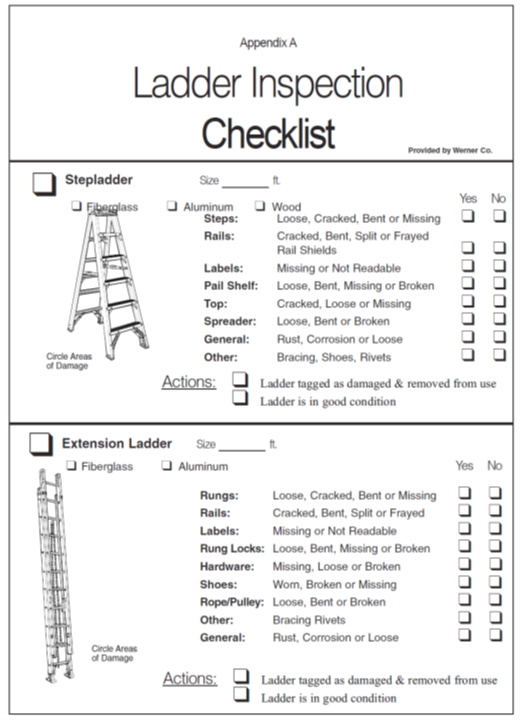
- Appendix A – Ladder Inspection Checklist
- Appendix B – Guidelines For Ladder Use
D. RESPONSIBILITIES
Supervisors
- Ensure all employees that use ladders receive ladder safety training before performing work.
- Enforce correct ladder.
- Provide the correct ladder types for the intended application(s).
- Ensure ladders are inspected when first placed into service, prior to every use, and immediately after potential damage from impact e.g. tip over, excessive heat or corrosive chemicals.
- Ensure ladders with defects are taken out of service immediately, affixed with an out-of-service or do-not-use sign and disposed as soon as possible.
Employees
- Participate in training when required.
- Select the appropriate portable ladder for the work activity.
- Maintain ladders in good, usable condition.
- Inspect ladders before each use by using the inspection checklist (Appendix A).
- Do not use defective ladders, take the ladder out of service immediately, and report the observed defects to their supervisor.
E. TRAINING
Training is provided to employees by the WSU Skillsoft plaform. In person training is also permitted by the unit. Re-training is required when an employee exhibits inadequate knowledge, skill or understanding or non-conforming use of ladders.
Training will require participants to demonstrate an understanding of WAC 296-876 and a proficiency using ladders. Training information will include:
- The proper selection, use, placement and care in handling and transporting ladders.
- The maximum intended load capacities of ladders that are used.
- How and when to inspect ladders.
Appendix B – Guidelines for Ladder Use
General
- Ensure ladders are set-up and secured to prevent accidental displacement or use barricades when in a location where they could be displaced by workplace activities or traffic. Place the ladder with a secure footing on a firm, level support surface. Do not place on snow, ice or other slippery surface unless it is secured or equipped with slip- resistant feet applicable to the support conditions.
- Ensure correct types of ladders are used so the maximum intended load (MIL), (MIL = the weight of the employee + tools) does not exceed manufacturer’s rated ladder capacity (see MIL ratings below).
- Ensure ladders are not moved, shifted, or adjusted while occupied by personnel.Do not place ladders on boxes, barrels or other unstable bases.
- Metal ladders shall not be used in the vicinity of energized electrical equipment or lines.Wood ladders shall not be painted with opaque paint, except for numbering purposes.
- Ladders transported on motor vehicles shall be properly supported and secured to the vehicle at all times to prevent damage.Do not use ladders for skids, braces, workbenches, or for any purpose other than climbing.When you are ascending or descending a ladder, do not carry objects that will prevent grasping the ladder with both hands.
- Always face the ladder when ascending and descending.Only one person is allowed on a ladder at a time.Do not jump from a ladder when descending.
- Ladder components must be free of grease and/or oil.Do not store portable ladders near sources of heat, moisture, or chemicals.
- Store portable ladders in a position to maintain straightness and to avoid impact damage.
Ladder Types
| Duty Rating | Ladder Type | Use | MIL Pounds |
| Extra Heavy Duty | IA | Industry, utilities, contractors | 300 |
| Heavy Duty | I | Industry, utilities, contractors | 250 |
| Medium Duty | II | Painters, offices, light maintenance, storage warehouse | 225 |
| Light Duty | III | General household type use | 200 |
Portable Step Ladders
- Do not place tools or materials on the steps or top cap of a stepladder.
- Do not use the top cap or top step of a stepladder as a step or stand.
- The top step can be used if it is 18” or more below the top cap.Always level all four feet and lock spreaders in place.Do not use a stepladder as a straight ladder or in a partially open position.
- Do not use or climb on the rear braces or shelf unless they are specifically designed for that purpose.
Portable Straight type or Extension Ladders
- Straight or extension ladders must extend at least three (3) feet beyond the supporting object when used to access an elevated work area.After raising the extension portion of a two or more stage ladder to the desired height, check to ensure that the safety dogs or latches are engaged.
- Set and use at a pitch so that the horizontal distance from the top support to the foot of the ladder is about one-quarter of the working length of the ladder.
- Place ladders so that side rails are equally supported by the top support, unless the ladder is equipped with a single support attachment.
- Make sure the top support of the ladder is reasonably rigid and able to support the load.All ladders must be equipped with safety (non-skid) feet.
- All extension or straight ladders must be secured or tied off at the top when work is to be performed on the ladder.
- Always use a full body harness with a lanyard that is secured to an anchor point rated for fall arrest and secure the ladder secured at the top and base when work requires the use of both hands and is more than 25 feet above the ground or floor.
- Work shall not be performed from a ladder more than 25 feet above the ground or floor if the work requires wearing eye protection or a respirator.
- Do not tie or fasten ladder sections together to make a longer ladder unless the manufacturer endorses this use and all manufacturer required fittings/attachments are available.
- Ensure each section of a multi-section ladder, when fully extended and locked in position to be used, overlaps the adjacent section as indicated in Table 2, Minimum Required Overlap for Extension Ladders.
Minimum Required Overlap for Extension Ladders
| If the ladder size (feet) is | Minimum required overlap for a two- section ladder is (feet) |
| Up to and including 36 | 3 |
| Over 36 and up to and including 48 | 4 |
| Over 48 and up to and including 60 | 5 |