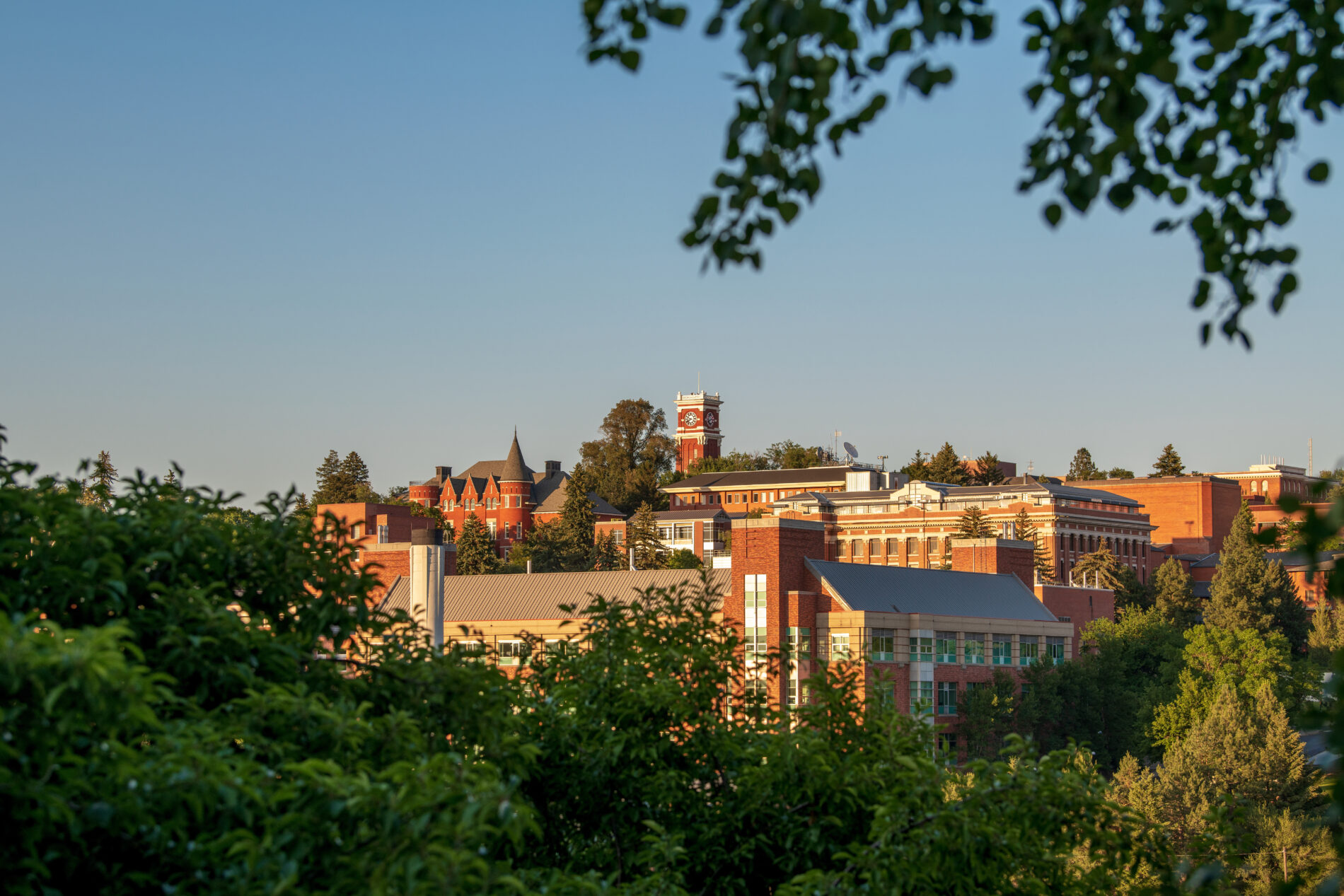
Theme: Research, Creativity, and Engagement
“Research, Creativity, and Engagement” is one of four main themes for the Voiland College of Engineering and Architecture (VCEA) 2023 – 2028 Strategic Plan.
Read the Executive Summary.
Goal
To further advance Voiland College’s innovative solutions and impactful research by engaging in strategic collaborative efforts.
Objectives
- Increase Voiland College’s inter- and transdisciplinary research collaborations.
- Support a diverse portfolio of fundamental and applied research and scholarship, with an emphasis on cultivating expertise in strategic areas with a cross-cutting appeal.
- Increase engagement of faculty and students with industry and community partners and other external stakeholders.
- Enhance a sense of community that promotes and celebrates scholarly inquiry and external engagement.
- Develop a world-class research program and innovation ecosystem that produces research products and solutions for global challenges.
Intended Outcomes
Voiland College will have a world-class reputation for developing and enhancing innovative research and creative activity.
Voiland College will be seen as a premier research institution where all students, staff, and faculty can attain their professional aspirations while contributing to the betterment of the world.
Strategic Planning Initiatives
VCEA aims to hire and retain excellent faculty at all levels by fostering engagement, recognition, and support. We plan to retain faculty through various initiatives, including connecting them with established researchers through events and system-wide programs, recognizing their accomplishments by nominating them for awards, providing training opportunities, and facilitating research team-building activities. Evaluation metrics include but not limited tracking inter-campus collaborations, hires, vacancies, and faculty departures, which indicate retention effectiveness.
VCEA aims to support the success of junior faculty by developing comprehensive training programs. These include workshops for regular NSF and NSF CAREER proposals, organized by the ADR office, Reading and Discussion Group sessions led by Assistant Dean Kacey Beddeos, and activities to foster connections outside VCEA, such as day trips to PNNL and Spokane Medical School. Qualified junior faculty will receive additional support from a professional writer for NSF CAREER. To enhance teaching, VCEA will support junior faculty participation in workshops like NETI. Evaluation metrics include the number of submitted and funded proposals, multi-disciplinary submissions, and junior faculty teaching evaluations, where possible. These efforts aim to bolster junior faculty’s research and teaching effectiveness.
VCEA’s strategy to enhance graduate student recruitment through invited faculty visits to top-tier universities. VCEA will prepare promotion materials and train faculty members on effective recruitment. Success is evaluated by tracking applications and admissions from targeted universities and gathering feedback from recruited students.
This activity aims to address the critical need for gap funding to support faculty during periods between research grants. The proposed gap funding program offers solutions by covering research and student expenses during interim periods, maintaining research momentum, enhancing faculty competitiveness, and supporting student success. Benefits include increased faculty productivity, improved graduate student quality, stronger research output, and a better institutional reputation.
VCEA aims to harness the strengths of its faculty across campuses, promote collaboration and foster a sense of belonging. Proposed strategies include travel funding for faculty to visit other campuses to establish new collaborations and give talks and travel support for faculty, staff, and students receiving VCEA awards to attend the events in Pullman. Additionally, travel funding would be provided for faculty and students participating in the annual research showcase and competitions. Success will be evaluated by tracking the number of inter-campus collaborations, new collaborative proposals, and students presenting work at different campuses, supporting a culture of connection and shared research progress across the VCEA system.
Graduate student fellowships are prestigious and competitive, showcasing the program’s quality. To support this, VCEA will offer training sessions for faculty and students on available fellowships, application processes, evaluation criteria, and timelines, potentially including panel discussions with experienced faculty reviewers. The initiative’s success will be assessed annually by tracking the number of fellowship applications submitted and awarded to VCEA graduate students.
Primary Metrics
| Metric | Lead | Source |
|---|---|---|
| The annual research expenditures within the college and per faculty. | VCEA Associate Dean of Research | WSU Office of Research |
| The VCEA faculty success rate of submitted proposals of value. | VCEA Associate Dean of Research | Academic Analytics |
| The number of scholarly research publications and associated products (patents, software, etc.) along with citation impact metrics within the college and per faculty. | VCEA Associate Dean of Research | WSU Office of Research, Web of Science, Office of Commercialization, Academic Analytics |
| The national and global ranking of Voiland College programs and disciplines. | VCEA Associate Dean of Research | Various ranking sources |
| The number of proposals submitted in collaboration with industry, community partners or other external partners. | VCEA Associate Dean of Research | ORSO |
| The number of inter- and transdisciplinary proposals submitted. | VCEA Associate Dean of Research | ORSO |
Scroll down or jump to a specific metric:
The annual research expenditures within the college and per faculty.
Source: WSU Office of Research.
- Research expenditure FY2023: $34M
- Number of tenure track faculty in FY23: 111
- Annual research expenditure per faculty in FY23: $308,000
The VCEA faculty success rate of submitted proposals of value (FY23).
- 2023 Grants per faculty = 1.15
- 2023 Percentage faculty with a grant = 51%
- 2023 Total grants = 188
- 2023 Dollars per grant = $170,718
- 2023 Grant dollars per faculty = $195,701
- 2023 Total grant $32,094,983
- 2023 Number of submitted proposals = 416
- 2023 Success rate = 45%
The number of scholarly research publications and associated products (patents, software, etc.) along with citation impact metrics within the college and per faculty.
Source: VCEA Office of Research/Academic Analytics.
FY23 Books
- Books per faculty = 0.49
- Percentage faculty with a book = 20%
- Total books = 80
FY23 Articles
- Articles per faculty = 14.08
- Percentage faculty with an article = 93%
- Total articles = 2309
FY23 Citations
- Citations per faculty = 351.37
- Percentage faculty with a citation = 95%
- Citations per publication: 20.21
- Total citations = 57,624
FY23 Awards
- Awards per faculty = 1.09
- Percentage faculty with an award = 48%
- Total awards = 178
FY23 Conference Proceedings
- Conference proceedings per faculty = 3.32
- Percentage faculty with a conference proceeding = 57%
- Total conference proceedings = 545
The national and global ranking of Voiland College programs and disciplines.
Source: VCEA Office of Research.
- 2023 U.S News and World Report Ranking: 85
- Electrical Engineering: 58
- Civil Engineering: 64
- Computer Engineering: 64
- Materials Science: 65
- Mechanical Engineering: 71
- Chemical Engineering: 72
- Computer Science: 83
Scroll down or jump to a specific metric:
The annual research expenditures within the college and per faculty.
Source: WSU Office of Research.
- Research expenditure FY2024: $39M
- Number of tenure track faculty in FY24: 124
- Annual research expenditure per faculty in FY24: $315,000
The VCEA faculty success rate of submitted proposals of value (FY24).
- 2024 Percentage faculty with a grant = 45%
- 2024: Number of submitted proposals = 247
- 2024 Success rate = 66%
The number of scholarly research publications and associated products (patents, software, etc.) along with citation impact metrics within the college and per faculty.
Source: VCEA Office of Research/Academic Analytics.
FY24 Articles
- Articles per faculty = 10.91
- Percentage faculty with an article = 0.88
- Total articles = 1604
FY24 Citations
- Citations per faculty = 332.12
- Percentage faculty with a citation = 0.87
- Citations per publication: 23.87
- Total citations = 48,822
The national and global ranking of Voiland College programs and disciplines.
Source: VCEA Office of Research.
- 2024 U.S News and World Report Ranking: 83
- Electrical Engineering: 58
- Civil Engineering: 64
- Computer Engineering: 64
- Materials Science: 65
- Mechanical Engineering: 71
- Chemical Engineering: 72
- Computer Science: 83
Scroll down or jump to a specific metric:
The annual research expenditures within the college and per faculty.
Source: WSU Office of Research.
- Research expenditure FY2025: $42M
- Number of tenure track faculty in FY25: 148
- Annual research expenditure per faculty in FY25: $284,000
The VCEA faculty success rate of submitted proposals of value (FY25).
- 2025 Percentage faculty with a grant = 45%
- 2025: Number of submitted proposals = 369
- 2025 Success rate = 68%
The number of scholarly research publications and associated products (patents, software, etc.) along with citation impact metrics within the college and per faculty.
Source: VCEA Office of Research/Academic Analytics.
FY25 Articles
- Articles per faculty = 9.72
- Percentage faculty with an article = 0.88
- Total articles = 1467
FY25 Citations
- Citations per faculty = 300.16
- Percentage faculty with a citation = 0.89
- Citations per publication: 23.73
- Total citations = 45,324
The national and global ranking of Voiland College programs and disciplines.
Source: 2025 US News and World Report Graduate Engineering Schools and Programs ranking.
- VCEA Overall Ranking: 89
- Electrical Engineering: 78
- Civil Engineering: 65
- Computer Engineering: 85
- Materials Science: 63
- Mechanical Engineering: 83
- Chemical Engineering: 78
- Computer Science: 94